Fifty Republics in One Republic
Fifty Republics in One Republic
The United States as a Country of Countries
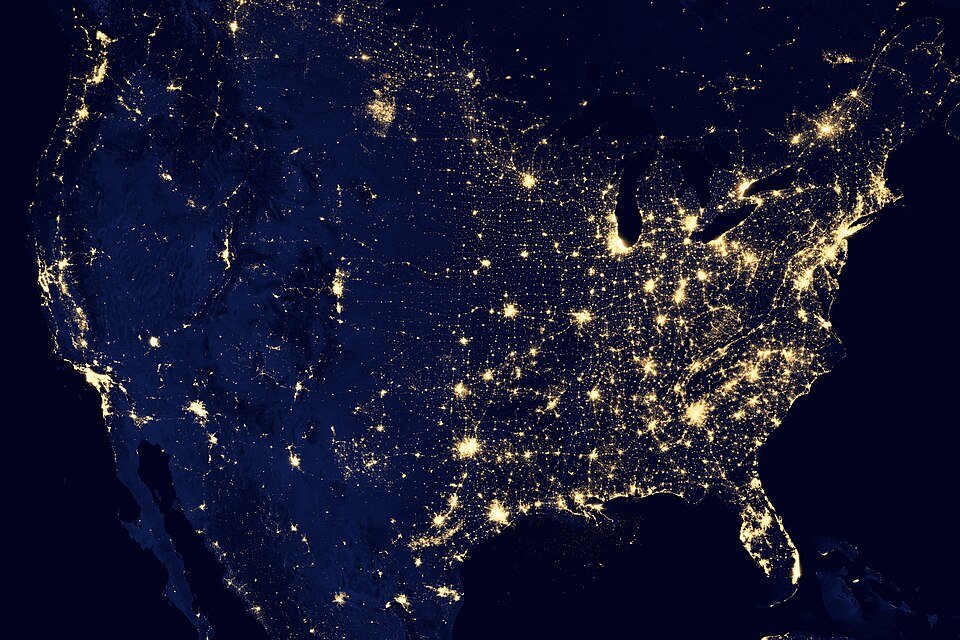
Image attribution: City Lights of the United States 2012.jpg via Wikimedia Commons.

The United States is often described as one country, which is administratively true and emotionally incomplete. It is also a federation of political personalities: fifty republics inside a larger republic, each with its own laws, myths, grudges, license plates, budget fights, favorite disasters, and preferred way of explaining itself to outsiders. Americans share a flag, a currency, a president, a military, a Supreme Court, and a talent for turning regional habits into national arguments. But they do not share one political culture so much as fifty overlapping versions of one.
This is not merely a travel-writer’s flourish. The American states are constitutional units, not decorative provinces. They run elections, police most crimes, license professions, fund schools, regulate land use, build roads, charter cities, administer Medicaid, set tax codes, and decide whether a person may buy wine in a grocery store on Sunday morning. They are large enough to matter and different enough to surprise. California has an economy that, measured crudely against nations, would rank among the world’s largest. Wyoming has fewer people than many American cities but the same number of United States senators. Texas maintains a political imagination capacious enough to include both global petrochemicals and the Alamo as a civic operating system. Vermont can make a town meeting feel like a constitutional sacrament. Florida can make a zoning hearing feel like a trailer for a streaming documentary.
The genius, or mischief, of American federalism is that it turns geography into government. A state is not just a place on the map; it is a legal machine for converting local preferences into public authority. This produces experimentation, duplication, competition, evasion, and occasional comedy. One state bans what its neighbor permits. One subsidizes an industry while another sues it. One builds a low-tax pitch to lure employers; another sells educated workers, transit, ports, or scenery. On any given issue—abortion, guns, marijuana, voting rules, school curricula, climate policy, labor rights—the United States is less a single argument than a noisy convention of delegations, each wearing its own badge and pretending not to glance at the others’ polls.
The phrase “laboratories of democracy,” associated with Justice Louis Brandeis, is overused because it is useful. States do try things. Sometimes they innovate. Sometimes they merely launder ideology through administrative detail. Sometimes they discover that a splendid theory collapses on contact with procurement rules. Yet the phrase captures something real: policies can begin in Sacramento, Austin, Madison, Boston, Tallahassee, or Salt Lake City before becoming national models, national warnings, or national punchlines. Welfare reform, environmental regulation, public health rules, tax limitations, school choice, marijuana legalization, and same-sex marriage all moved through state politics in different ways before reshaping national debate.
To understand America through Washington alone is therefore like judging a corporation only by its headquarters lobby. The boardroom matters. So do the regional managers, the franchisees, the distribution centers, and the local staff who know which bridge is falling down. The federal government raises the grand constitutional questions and writes the giant checks. States decide much of what daily government feels like. They are where a driver gets a license, a teacher follows a curriculum, a prisoner serves a sentence, a business files paperwork, a utility seeks approval, and a governor declares an emergency while wearing a fleece vest embroidered with the state seal.
The states also preserve older histories that the national story often tidies up. The original thirteen began as colonies with different churches, economies, settlement patterns, and relations with Native peoples. Later states entered through purchase, conquest, treaty, migration, speculation, and compromise. Some were carved from territories by Congress. Some were shaped by slavery and its abolition, by railroads and mining camps, by homesteads and reservations, by ports and plantations, by canals, timber, oil, aerospace, tourism, and software. State borders can look arbitrary until one remembers that arbitrariness is often just a political deal that survived long enough to become geography.
This makes the American map a record of ambition and avoidance. The Mason-Dixon Line became shorthand for a national fracture it did not create by itself. The rectangular states of the West suggest surveyors, railroads, and federal land policy more than organic community. New England’s small states reflect
How States Work: Constitutions, Governors, Legislatures, Courts, Counties, Cities, and Tribes
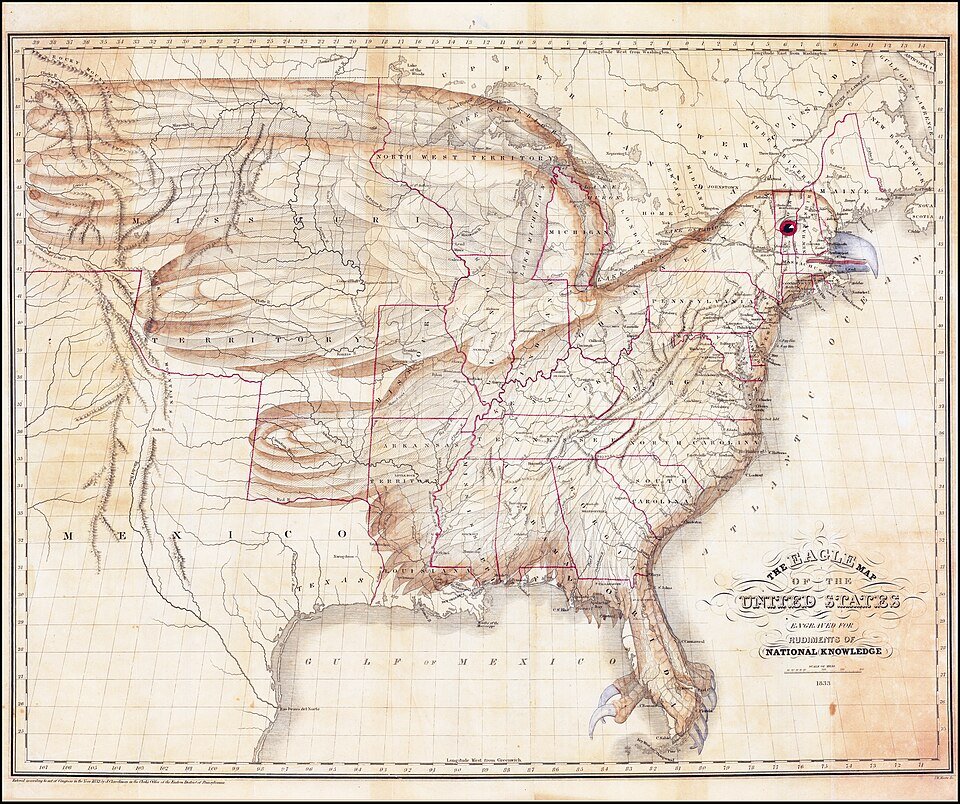
Image attribution: Eagle Map of the United States Engraved For Rudiments of National Knowledge, edit.jpg via Wikimedia Commons.

A state is not simply a colored shape on a schoolroom map. It is a government with its own constitution, executive officers, legislature, courts, tax system, agencies, police powers, public universities, prisons, pension obligations, scandals, slogans, and stationery. It can be majestic in theory and exasperating in practice, which is one reason Americans argue about states with the special warmth reserved for relatives and contractors.
Every state has a constitution. Some are spare enough to be read without provisions for coffee. Others are sprawling civic attics, packed with amendments, fiscal restraints, policy instructions, local exceptions, and relics of past political brawls. The federal Constitution is famously difficult to amend; many state constitutions are amended with comparative frequency, sometimes by legislative referral, sometimes by voter initiative, sometimes by constitutional convention. This gives state government a democratic immediacy and, occasionally, the air of a hardware store bulletin board. California’s constitution, for example, has been repeatedly shaped by ballot propositions. Alabama long had one of the world’s longest constitutions before voters approved a reorganized version in 2022. The difference is not merely literary. State constitutions often determine taxation, education finance, criminal procedure, local government powers, environmental rules, and the rights citizens can claim beyond the federal floor.
At the visible center stands the governor, the nearest American equivalent to a provincial premier with a disaster podium. Governors propose budgets, sign or veto bills, appoint officials, command the state National Guard when not federalized, and become the face of storms, fires, epidemics, prison escapes, bridge collapses, and economic announcements involving hard hats. Their formal powers vary. Some enjoy strong appointment authority and line-item vetoes; others share power with independently elected officials such as attorneys general, treasurers, auditors, secretaries of state, agriculture commissioners, or insurance commissioners. In many states, executive authority is deliberately fragmented. This was not an accident. Americans like executive leadership, but they also like putting executives on a leash and then complaining that the dog will not run faster.
State legislatures are where much of the real machinery turns. Every state but Nebraska has a bicameral legislature, with a house and senate. Nebraska, eccentric in a manner both high-minded and prairie-practical, has a unicameral legislature that is officially nonpartisan, though politics has not been abolished there any more than weather has. Legislatures write criminal laws, set taxes, draw budgets, regulate professions, structure school systems, fund roads, pre-empt cities, subsidize industries, and decide whether some problem requires a commission, a crackdown, a tax credit, or all three. They are also laboratories of political ambition. A statehouse is where future members of Congress learn to count votes, and where future governors learn that every appropriation has a mother, a lobbyist, and a funeral if cut.
Then there are the courts. State courts handle the overwhelming majority of American litigation: divorces, contracts, probate, landlord-tenant disputes, personal injury claims, most criminal prosecutions, and the endless ordinary collisions of human life. State supreme courts interpret state constitutions, review statutes, oversee lower courts, and sometimes become national actors, especially on voting rules, abortion, school funding, redistricting, environmental law, and criminal justice. Judges may be appointed, elected, retained by voters, or chosen through hybrid systems. Judicial elections can seem odd to outsiders: democracy in a robe, sometimes financed by interests that may later appear before the bench. But they reflect a recurring American instinct: if power exists, someone should have to campaign for it.
Below the state sit counties, though their importance varies wildly. In much of the South and West, counties are central units of administration, law enforcement, courts, roads, land records, public health, and elections. The county sheriff can be a major figure, especially in rural places where the courthouse is both symbol and switchboard. In New England, by contrast, towns often matter more, and county government is limited or, in some states, partly abolished. Louisiana has parishes rather than counties, a reminder that French
The Regional Map: New England, the Mid-Atlantic, the South, the Midwest, the Mountain West, the Pacific, Alaska, and Hawaii
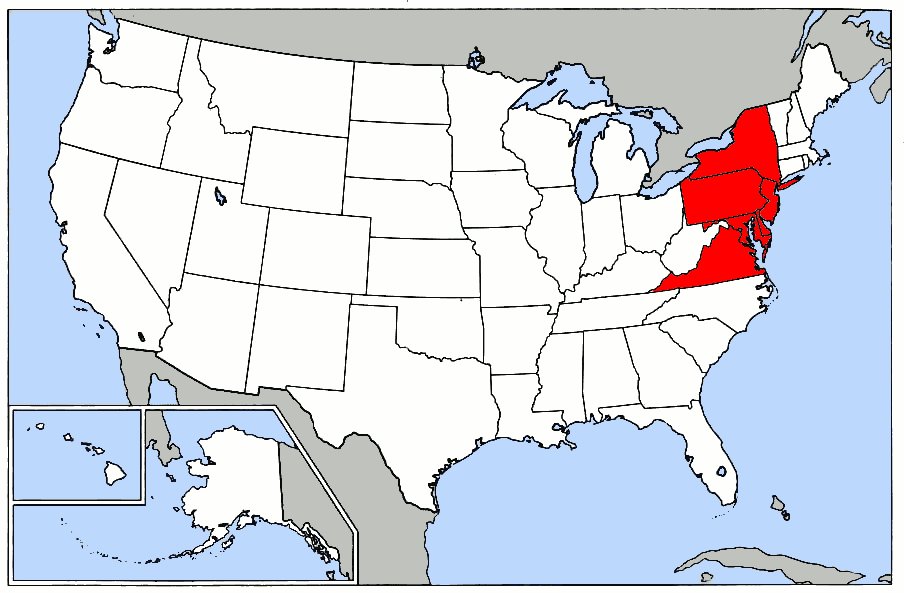
Image attribution: Map of USA highlighting Mid-Atlantic states.png via Wikimedia Commons.
Regions are America’s unofficial second constitution. They have no fixed legal force, no uniform borders, and no agreed membership committee. Yet they shape accent, cuisine, religion, settlement patterns, partisan habit, economic structure, and the jokes people tell about one another at airports. A state is a jurisdiction; a region is a temperament with weather.
The trouble is that American regions are both real and slippery. Maryland is Southern until it is suburban Washington. Pennsylvania is Mid-Atlantic until Pittsburgh starts sounding like the Midwest and the northern tier looks toward the Great Lakes. Texas is Southern, Western, borderland, oil province, spaceport, and self-regarding continental power, depending on which exit one takes. Florida is the South in the Panhandle, the Caribbean in Miami, the Midwest in retirement communities, and New York with palm trees in parts of the coast. The regional map is not a filing cabinet. It is a stack of transparencies.
New England: The Town Meeting and the Hard Winter
New England is the oldest Anglo-American regional idea, and it behaves like it knows it. Massachusetts, Connecticut, Rhode Island, New Hampshire, Vermont, and Maine share a history of Puritan settlement, maritime trade, early industry, compact towns, and a habit of arguing in public with procedural confidence. Its civic mythology is unusually durable: town meetings, village greens, stone walls, white steeples, old colleges, abolitionist memory, Yankee thrift, and winters that seem designed as character witnesses.
The caricature of New England as flinty, overeducated, and allergic to nonsense exists because enough of it is rooted in observable things: high educational attainment, dense civic institutions, old municipalities, and a long tradition of moral politics, from reform movements to environmentalism. But the region is not a museum of scolding Congregationalists. It includes old mill cities with large immigrant histories, fishing communities, defense contractors, biotech corridors, ski towns, struggling rural counties, hedge-fund suburbs, and Boston, which has successfully monetized both intellect and resentment of traffic.
Politically, New England today is mostly Democratic at the federal level, though New Hampshire remains more competitive than its neighbors, and Republican governors have often succeeded in several states by presenting themselves as managers rather than crusaders. It is liberal, yes, but not uniformly radical; its politics often combine social tolerance, fiscal caution, local control, and a deep suspicion that someone somewhere is doing development badly.
The Mid-Atlantic: Ports, Power, and Argument
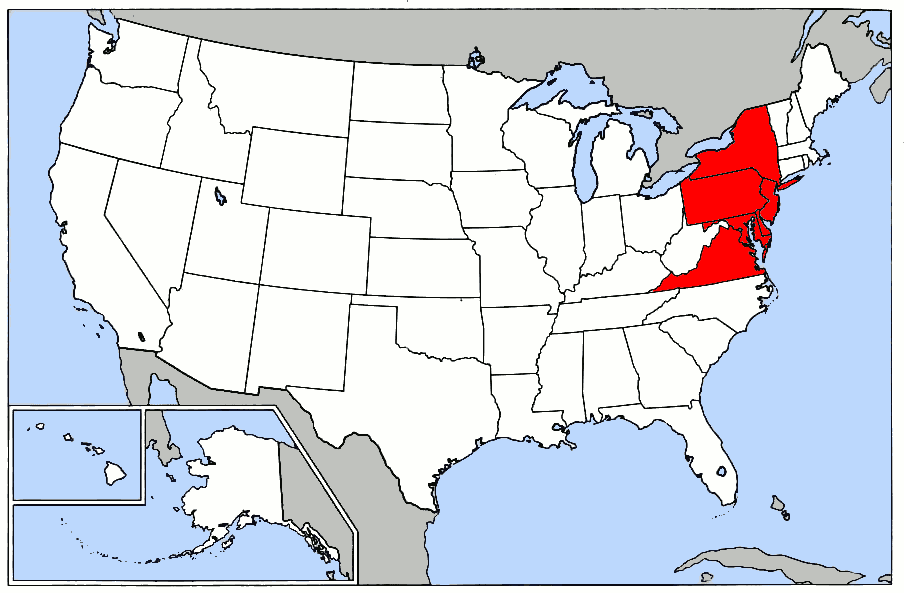
The Mid-Atlantic is America’s hinge: New York, New Jersey, Pennsylvania, Delaware, Maryland, and often the District of Columbia’s orbit, though D.C. is not a state and never lets anyone forget the consequences. This is the region of great ports, rail corridors, finance, media, immigrant neighborhoods, rowhouses, suburbs, universities, machine politics, and national government. If New England supplied the sermon and the South supplied the plantation, the Mid-Atlantic supplied the invoice, the newspaper, and the committee hearing.
Its reputation for impatience is not wholly unfair. Dense settlement produces friction; friction produces direct speech; direct speech produces regional branding. New York City alone can distort any national map, not merely because of its size but because it is a global capital of money, culture, migration, and self-narration. New Jersey’s comic role as America’s punchline is one of the country’s lazier habits, given that it is wealthy, diverse, strategically located, and home to everything from pharmaceutical headquarters to pine barrens. Pennsylvania contains Philadelphia, Pittsburgh, old coal country, Amish farms, college towns, and vast stretches that have often decided statewide elections. It is less a swing state than a domestic argument with borders.
The Mid-Atlantic’s politics are similarly mixed. Major metropolitan areas lean Democratic; exurban and rural counties often lean Republican; organized labor, ethnic politics, Black political power, suburban moderation, and postindustrial grievance all have deep roots. It is a region built on circulation—of goods, people, capital, and opinions loudly expressed on trains.
The South: Memory, Growth, and the Courthouse Square
Fifty State Portraits: Character, Reputation, Politics, and What Each Is Known For
A state portrait is not a mugshot. It should catch the angle of the face without pretending the person has only one expression. Still, reputations persist because they usually contain a seed of truth, watered generously by outsiders.
Alabama is known for football, civil-rights history, military and aerospace work around Huntsville, and a conservative politics still shadowed by the Black Belt’s history. Alaska is vast, resource-rich, strategically military, proudly remote, and politically individualist in ways that do not always fit mainland categories. Arizona has become a migration and sunbelt-growth state: desert retirement, border politics, Native nations, Phoenix sprawl, and a recent habit of close elections. Arkansas is smaller and poorer than many neighbors but politically important beyond its size, with Walmart, poultry, rice, the Ozarks, and the long afterlife of the Clinton years.
California is the republic’s great contradictory province: Hollywood and Silicon Valley, agriculture and homelessness, environmental law and freeway civilization, one-party Democratic dominance and endless local rebellion. Colorado sells mountains and moderation, though its politics have moved left as Denver and its suburbs have grown; it is outdoorsy, educated, and not quite as laid-back as the ski brochures suggest. Connecticut is insurance, hedge funds, old Yankee towns, deep inequality, and a politics that is blue but fiscally attentive. Delaware is tiny, corporate, beachy, and more powerful in company law than its size has any right to be.
Florida is America’s fever dream with palm trees: retirees, immigrants, tourism, hurricanes, real estate, Cuban-American politics, Disney, and an increasingly Republican statewide profile. Georgia is Atlanta plus everything Atlanta is not: logistics, film, Black political power, evangelical conservatism, suburbs, farms, and now genuine electoral competition. Hawaii is Pacific, Asian-American, Native Hawaiian, military, tourist, and geographically American in law but culturally far from the mainland’s usual habits. Idaho is mountains, potatoes, public land, fast growth around Boise, and a conservatism sharpened by newcomers and old western suspicion of federal reach.
Illinois is Chicago and the rest, which is not fair but is politically useful: finance, food, universities, prairie towns, unions, machine memories, and Democratic control anchored by the metropolis. Indiana is manufacturing, basketball, churches, Indianapolis, and a business-minded conservatism with Midwestern manners. Iowa is corn, caucus mythology, insurance, wind power, and small-town civic culture, though its politics have moved right in recent years. Kansas is wheat, aviation, suburbs, populist ghosts, and a Republican identity complicated by periodic fights over taxes, schools, and abortion.
Kentucky is bourbon, horses, coal country, Louisville, Appalachia, and conservative politics threaded with labor and New Deal memories. Louisiana is oil, ports, jazz, Catholic parishes, Cajun and Creole culture, and a political tradition so colorful that “colorful” often sounds like an audit term. Maine is rocky, rural, older, independent-minded, and environmentally conscious, with politics that reward personal brands more than party scripts. Maryland is federal suburbia, Baltimore, the Chesapeake, Black affluence and inequality, and a reliably Democratic state with sharp regional contrasts.
Massachusetts is universities, biotech, hospitals, old reformism, sports grievance, and liberal politics administered with Puritan confidence. Michigan is automobiles, lakes, unions, Detroit, Arab-American and Black political power, and the industrial Midwest’s central argument about decline and reinvention. Minnesota is lakes, co-ops, medical excellence, Scandinavian-inflected civic habits, and Democratic strength that survives despite rural Republican gains. Mississippi is blues, literature, poverty, agriculture, a large Black population, and conservative state politics shaped by one of the country’s hardest histories.
Missouri is the border state that became a red state: St. Louis, Kansas City, the Ozarks, agriculture, beer, and a faded bellwether reputation. Montana is big sky, ranching, mining, public land, libertarian instincts, and a politics pulled between old labor Democrats and newer Republican dominance. Nebraska is corn, cattle,
The Stereotype Machine: Cowboys, Yankees, Californians, Floridians, Texans, and Other Useful Myths
A country of fifty republics needs shorthand. Nobody has time, during an argument over taxes or football, to recite the entire history of Pennsylvania’s coal fields, Quaker inheritance, suburban realignment, union decline, fracking politics, machine cities, Amish farms, and Wawa-Sheetz diplomacy. So America reaches for caricature. The cowboy. The Yankee. The Hollywood Californian. The Florida Man. The Texas oilman. The New York operator. The Midwestern nice person with a casserole and an unspoken grievance. These figures are crude, unfair, and surprisingly durable. They are not maps. They are weather vanes.
Stereotypes work because they contain a splinter of truth wrapped in a bale of convenience. They compress economics, settlement patterns, climate, race, religion, class, and political memory into a costume. The cowboy is not simply a man on a horse. He is the national fantasy of land without limits, government without forms, masculinity without meetings. The Yankee is not merely a New Englander. He is thrift, education, town government, moral busybodyism, and the suspicion that enjoyment should be properly licensed. The Californian is reinvention with better lighting: gold rush, film, aerospace, counterculture, venture capital, yoga, wildfire, and zoning litigation. The Floridian is the American id released into humidity. The Texan is sovereignty performed at volume.
All are myths. All do work.
The first work is commercial. States sell themselves. “Pure Michigan,” “Virginia is for Lovers,” “I ♥ NY,” “What Happens Here, Stays Here,” and the many official and unofficial slogans of state promotion are not policy papers. They are mood boards with tax implications. Tourism boards turn landscapes into character traits. Mountains become freedom; beaches become ease; cities become possibility; small towns become authenticity; deserts become spiritual clarity, especially if the hotel has a spa. A state’s image is a development strategy. Attract visitors, then retirees, then corporate relocations, then a university conference on why housing has become unaffordable.
The second work is political. Caricature makes coalition-building easier. “Real America” is almost always located somewhere conveniently outside the speaker’s opposition. For some conservatives, it means rural counties, churches, gun culture, military service, and suspicion of metropolitan elites. For some liberals, it means immigrant neighborhoods, public universities, dense cities, environmental virtue, and the country’s future arriving ahead of schedule. Both visions require editing. Rural America contains methadone clinics, solar farms, Latino meatpacking workers, and gay teenagers. Urban America contains police unions, small landlords, church ladies, and people who would very much like lower taxes. The myth survives by cropping the photograph.
Regional stereotypes also discipline politicians. A Massachusetts Republican must explain that he is not that kind of Republican. A West Virginia Democrat, when one can be found in statewide office, must prove independence from national liberalism before breakfast. A California governor is assumed by half the country to be running a lifestyle brand; a Texas governor is assumed by the other half to be running a flagpole. New Yorkers are expected to be blunt, Nebraskans decent, Alabamians conservative, Vermonters eccentric, Arizonans allergic to Washington, and Louisianans one indictment away from dinner. The expectations are often lazy. They are also political assets. A leader can lean into the role, rebel against it, or weaponize the accusation.
The cowboy myth is especially instructive because it is both regional and national. Its historical roots lie in ranching, cattle drives, Spanish and Mexican vaquero traditions, Indigenous dispossession, Black and Mexican cowhands, and the post-Civil War expansion of the cattle industry. Its popular version came filtered through dime novels, Wild West shows, Hollywood, country music, and political theater. Wyoming, Montana, Colorado, Oklahoma, New Mexico, Texas, the Dakotas, and parts of California all have claims on the story. Yet the cowboy became less an occupation than a theory of citizenship: self-reliant, armed, plainspoken, impatient with bureaucracy, and rarely shown repairing a fence in freezing rain.
New England’s Yankee is another long-running production. The image
Red, Blue, Purple, and Stranger Than That: State Politics Beyond the Electoral Map
The laziest American political map is also the most popular: red states, blue states, and the small set of purple ones where cable-news correspondents grow visibly dehydrated every four years. It is useful, as all crude instruments are useful. A hammer can drive a nail. It can also make a poor watch repair tool.
The red-blue map tells us how states vote for president, usually by winner-take-all electoral votes, and then tempts us to believe that it has explained the place. It has not. California is blue, but it contains more Republican voters than many red states have people. Texas is red in recent presidential elections, but its big cities vote Democratic, its suburbs have shifted, and its border politics do not always behave according to national scripts. Illinois is blue because Chicago and its suburbs are enormous; drive far enough south and one enters a political climate that feels more like Missouri or Kentucky. New York is Democratic in presidential contests, yet Long Island, Staten Island, the Hudson Valley, and upstate counties can produce politics quite unlike Park Slope. A state is not a precinct with mountains.
The states became red and blue in the television age, but their politics were strange long before graphics departments got involved. For much of the twentieth century, the national parties were internally contradictory coalitions. Conservative southern Democrats shared a party label with northern liberals. Liberal or moderate Republicans governed in New England and parts of the Pacific Coast. The civil-rights revolution, suburban realignment, the rise of the religious right, the decline of union power, and the sorting of college-educated voters all helped produce the more ideologically coherent parties of today. But states did not all march in formation. They dragged their histories behind them like tin cans tied to a wedding car.
That is why state politics are best understood in layers. The first layer is presidential voting. The second is statewide office: governors, senators, attorneys general, secretaries of state. The third is legislative control, where district lines, geography, turnout, and incumbency matter hugely. The fourth is local government, where national ideology often gets mugged by potholes, zoning, police contracts, school-board fights, and the eternal question of who pays for the new wastewater plant. The fifth layer is ballot measures, available in many states but especially important in the West, where voters sometimes behave like a legislature after three cups of coffee.
These layers do not always match. Vermont has been one of the most Democratic states in presidential politics, yet it has repeatedly elected Republican Phil Scott as governor, a moderate in a state where moderation is not a synonym for boredom but a survival strategy. Massachusetts, safely Democratic for president, has often been willing to hire Republican governors as fiscal chaperones, including Mitt Romney and Charlie Baker. Maryland, another Democratic presidential state, elected Republican Larry Hogan twice. Kansas, reliably Republican in presidential elections, elected Democrat Laura Kelly as governor. Kentucky, deep red for president, has elected Democratic governors, including Andy Beshear. Louisiana has done the same with John Bel Edwards. These examples do not prove that partisanship is weak. They prove that state voters sometimes keep a small drawer for exceptions.
The reverse happens too. States that look competitive at the top may contain entrenched legislative majorities. Wisconsin is the classic civics-class migraine: closely divided in statewide elections, yet long marked by intense battles over legislative maps, union power, courts, and administrative authority. North Carolina is another: a genuine battleground for president and governor, but also a place where legislative power, redistricting, and judicial elections have turned state politics into a year-round constitutional argument. Pennsylvania, Michigan, Arizona, Nevada, and Georgia are purple in different dialects, each with its own mixture of metropolitan growth, rural resistance, suburban education levels, Black, Latino, Asian American, Indigenous, and immigrant electorates, and the local memory of what the parties have done lately.
“Purple,” in fact, is too polite a word. It suggests a smooth blend, as if Democrats and Republicans had been stirred together by a patient art teacher. Many purple states are not blended; they are polarized mosaics. Georgia’s Democratic gains have been driven by metro Atlanta’s growth, Black political organization, and suburban change, while much of
State Economies and Global Reach: Farms, Finance, Oil, Tech, Tourism, Ports, Universities, and Soft Power
A state is not merely a political unit with a flag, a capitol dome, and a suspiciously energetic tourism slogan. It is also an economic machine: a producer of food, code, oil, insurance policies, movie franchises, aircraft parts, legal disputes, college graduates, and plausible reasons to build another interstate interchange. The American economy is national in its currency and continental in its scale, but it is intensely state-shaped in its habits. To say “the American economy” is useful; to stop there is to miss the fact that Iowa and Manhattan are not engaged in the same daily experiment.
California is the obvious colossus, which is one reason the rest of the country enjoys resenting it. Were it independent, its economy would rank among the world’s largest. That fact is now invoked so often that it has become less an observation than a regional mating call. But California’s scale matters because it combines several economies that elsewhere would be separate kingdoms: Silicon Valley’s technology firms, Hollywood’s entertainment apparatus, the Central Valley’s agricultural production, world-class universities, defense and aerospace legacies, Pacific ports, and a vast consumer market. It exports software and almonds, movies and medical devices, political styles and lifestyle neuroses. Its caricature as a land of surfers, coders, and regulatory pamphlets exists because all three are real, though unevenly distributed.
New York’s economic power is older and more vertical. Wall Street is not the whole state, but it is the part that foreigners can find without a map. Finance, media, law, advertising, fashion, higher education, and real estate make New York a global nerve center. Upstate, meanwhile, has manufacturing history, universities, agriculture, and the long shadow of industrial decline and reinvention. The state’s image problem is that New York City is so loud it makes Buffalo, Rochester, Syracuse, Albany, and the North Country seem like supporting characters in a show they did not audition for.
Texas is the other giant with a plausible claim to being a national economy in cowboy boots. Oil and gas remain central not just as symbols but as infrastructure, capital, expertise, and political identity. Yet Texas is also a technology state, a logistics state, a medical state, a university state, a space state, and an immigrant entrepreneurial state. Houston is energy and medicine with a port attached; Dallas-Fort Worth is corporate headquarters, aviation, finance, and sprawl executed at heroic scale; Austin is government, software, music, and self-consciousness. The cowboy stereotype survives because oilmen, ranches, and frontier mythology are still culturally useful. It fails because modern Texas is also suburban Asia, Latino borderlands, Nigerian Houston, Indian Plano, and Tesla near Austin.
Florida sells weather, retirement, cruises, beaches, theme parks, real estate, and the pleasing fiction that geography can repeal mortality. Tourism is its most famous export, but the state also has agriculture, aerospace on the Space Coast, logistics, health care, finance, and a large role in hemispheric commerce. Miami is not simply a beach city with better shoes than judgment; it is a capital of Latin American business, media, banking, exile politics, art, and property speculation. Florida’s reputation for absurdity rests partly on open-records laws that make strange arrests easy to publicize, partly on rapid growth, and partly on the recurring human mistake of mixing heat, water, money, reptiles, and ambition.
The Midwest remains the country’s workshop and pantry, though both labels need updating. Illinois has Chicago: a financial, logistics, legal, architectural, educational, and cultural hub placed with almost indecent strategic sense near the Great Lakes and the continent’s rail networks. Indiana, Ohio, Michigan, and Wisconsin carry manufacturing legacies that have been battered, automated, globalized, and in some cases revived. Michigan is still inseparable from the auto industry, even as electric vehicles and batteries redraw the map of factories and suppliers. Iowa, Nebraska, Kansas, Minnesota, and the Dakotas are farm states in the public imagination, but modern agriculture is not a man chewing straw
Rivalries, Dependencies, and Compacts: How States Compete, Cooperate, and Annoy One Another
American federalism is often described as a constitutional arrangement, which is true in the same way that marriage is a legal status. It is also a daily negotiation over money, water, roads, taxes, pride, resentment, and who gets to claim the airport. States are not sealed jars on a shelf. They are roommates with different incomes, suspicious habits, and shared plumbing.
They compete for companies, residents, tourists, factories, federal dollars, college students, sports teams, film shoots, ports, and bragging rights. They cooperate because rivers ignore borders, power grids require neighbors, criminals cross county lines, and commuters have a poor grasp of political theory. They annoy one another because that is what neighbors do.
The cleanest example is economic rivalry. States have spent decades offering tax breaks, grants, infrastructure, cheap land, and gubernatorial courtship to lure employers. The competition can be productive when it forces states to improve roads, schools, permitting, workforce training, and quality of life. It can also become an expensive auction in which public money is used to subsidize decisions companies might have made anyway. Governors announce such victories in front of hard hats and flags. The invoices arrive later, less photogenic but no less real.
This competition helps explain why certain state caricatures exist. Texas boasts of low taxes, light regulation, and business swagger because it has successfully sold those qualities to firms and families. California defends its higher-cost model with talent, capital, universities, climate, culture, and a stupendous concentration of industries that complain about the state while remaining inconveniently present. Florida sells sunshine and tax avoidance with the grin of a man who knows the moving van is already on the interstate. New York and New Jersey snipe over commuters, corporations, and tunnels while sharing one of the world’s great metropolitan economies and a talent for mutual grievance.
Borders are where state myths meet practical dependency. Northern New Jersey is tied to New York City by trains, tunnels, bridges, salaries, and neurosis. Southern New Jersey looks as much toward Philadelphia as toward Manhattan. Northern Kentucky is woven into metropolitan Cincinnati. Indiana supplies workers and suburbs to Chicago; western Wisconsin and eastern Minnesota share the Twin Cities orbit; Kansas and Missouri have turned Kansas City into both a civic fact and a jurisdictional argument. The Washington region makes this especially vivid: the capital sits in the District of Columbia, while much of its workforce, contractors, wealth, and political weather system spill across Maryland and Virginia. Nobody designed American identity to fit commuting patterns. Commuting patterns took the news with composure.
Then there are the formal instruments of cooperation, less glamorous than rivalry but more important than stump speeches. Interstate compacts allow states to manage shared problems with congressional consent when needed. The Port Authority of New York and New Jersey, created in 1921, runs major bridges, tunnels, airports, ports, and the PATH rail system; it is a monument to the proposition that even states with a gift for bickering can build things together when commerce leaves them no choice. The Colorado River Compact of 1922 divided rights to a river on which the modern Southwest depends, though its assumptions about water supply have been strained by drought, growth, and climate change. The Great Lakes states and Canadian provinces have developed agreements to manage the world’s largest surface freshwater system, because freshwater is one of those resources people appreciate most keenly when someone else wants to pipe it away.
Water, in fact, may be the most honest federalist tutor. Western states learned long ago that property ideology does not fill reservoirs. California, Arizona, Nevada, Colorado, New Mexico, Utah, Wyoming, and others are tied together by river law, dams, irrigation districts, federal agencies, tribal rights, urban growth, farms, and the arithmetic of snowpack. The fights can sound parochial: almonds versus lawns, Las Vegas versus alfalfa, upstream versus downstream. But beneath them lies a continental question: how much settlement and agriculture can be supported in dry places, and who must adjust when yesterday’s promises exceed today’s water?
Electricity offers another lesson. Power grids cross state lines because electrons are poor localists. Regional transmission organizations and independent system operators manage wholesale electricity markets in much of the country, though arrangements vary by region
The States Abroad: Immigration, Trade, Diasporas, Military Bases, Climate Diplomacy, and Cultural Exports
A state is not a nation, which is a useful legal fact and a poor description of reality. American governors do not sign peace treaties. State legislatures do not recognize foreign governments. Vermont cannot declare a naval blockade, though one suspects it could organize a sternly worded town meeting. Yet the states live abroad all the time. They trade, recruit, host, export, lobby, welcome, repel, translate, entertain, and occasionally alarm the world. If Washington conducts foreign policy in the formal sense, the states conduct it in the practical one: through cargo cranes, college admissions offices, military installations, sister-city programs, diaspora churches, semiconductor subsidies, climate pledges, film studios, soybean contracts, and airports full of relatives carrying gifts.
Immigration makes this most visible. The old Ellis Island story was never simply national; it landed in neighborhoods, factories, farms, schools, and ward machines. Today the geography is broader. California, Texas, Florida, New York, and New Jersey have large foreign-born populations, but so do Nevada and Maryland; meatpacking and agriculture have remade towns in Iowa, Nebraska, Kansas, and North Carolina; Somali communities have become part of Minnesota’s political and civic life; Vietnamese Americans are central to places from Orange County to Houston; Cuban Americans helped define modern Miami; Hmong communities shaped parts of Wisconsin and Minnesota; Mexican and Central American migration has altered nearly every region. The famous caricatures—California as Latin America with venture capital, Florida as the Caribbean’s northern annex, Texas as a border state with oil money and opinions—exist because they exaggerate something real.
Diasporas give states foreign-policy nerves of their own. Cuban politics mattered in Florida long before every campaign consultant discovered the word “Latino” was not a voting bloc. Armenian Americans in California, Jewish communities in New York and elsewhere, Arab American communities in Michigan, Irish Americans in Massachusetts, Polish Americans in Illinois, Indian Americans in New Jersey and Texas, and Korean Americans in California and Georgia connect state politics to overseas memory, grievance, commerce, and kinship. These ties do not produce uniform views; diasporas argue as energetically as everyone else. But they do make foreign events local. A war, earthquake, election, or diplomatic crisis can arrive not as an abstraction from cable news but as a call from an aunt, a remittance problem, a protest outside city hall, or a fundraiser in a suburban banquet room.
Trade gives the states another passport. California sells technology, entertainment, almonds, wine, and university prestige. Texas exports oil, gas, chemicals, machinery, cotton, beef, and a certain scale of self-advertisement that probably deserves its own tariff classification. Washington state looks across the Pacific through aircraft, software, apples, wheat, and ports. Louisiana’s lower Mississippi is an industrial throat through which grain, petroleum, chemicals, and ambition move. Georgia has turned Atlanta and Savannah into instruments of global logistics. South Carolina and Alabama assemble foreign-branded automobiles with local workers and state incentives, a tidy reminder that globalization often arrives wearing a hard hat rather than a Davos lanyard. The Midwest sells soybeans, corn, pork, machinery, medical devices, and risk management. When China buys fewer soybeans, it is not “America” in the abstract that feels the pinch; it is farmers, elevators, railroads, river towns, and governors suddenly fluent in export statistics.
Ports are the most literal points of contact. Los Angeles and Long Beach handle enormous Pacific trade. New York and New Jersey remain a vast Atlantic gateway. Houston is a petrochemical and energy giant. Savannah has grown into one of the country’s most important container ports. Seattle, Tacoma, Oakland, Charleston, Norfolk, Miami, New Orleans, and others each reveal a version of America pointed outward. The port city is often the least sentimental kind of cosmopolitan: it may talk about heritage, but it thinks in manifests, dredging depths, customs procedures, warehouse space, and truck queues.
The military also internationalizes states, though with less romance. Virginia, California, Texas, North Carolina, Georgia, Florida, Washington, Hawaii, and others host major bases and defense industries. Norfolk is inseparable from the Navy. San Diego is a Pacific military city
Conclusion: Why the States Still Matter in the American Imagination
The American states endure because they solve a problem the country never stops having: how to be enormous without becoming entirely abstract. The United States is too large, too rich, too quarrelsome, too mobile, and too myth-stuffed to fit comfortably inside one national story. The states make the republic legible. They give Americans smaller stages on which to perform the national drama, with local costumes, accents, heroes, villains, budget fights, football teams, zoning wars, water disputes, and license plates.
They also give the country an alibi. When Americans wish to praise themselves, they speak of the nation. When they wish to explain failure, they discover federalism. The genius of the system is that both instincts contain some truth. Washington may set the grand terms of American life—war and peace, money and borders, constitutional rights, national spending—but states decide much of the daily texture: schools, policing, roads, land use, business regulation, public health, elections, prisons, universities, professional licensing, energy siting, and the practical meaning of many federal programs. A citizen may salute the same flag in Oregon and Mississippi, but the state will help decide what taxes she pays, how her child’s school is funded, whether a train is plausible, how easy it is to vote, how electricity is generated, and what happens when the sheriff, the landlord, the employer, or the river misbehaves.
This is why state reputations have such staying power. They are shortcuts, sometimes cruel, often funny, occasionally useful. New York is impatient; California is utopian until the permitting begins; Texas is large and would like you to know it; Florida is the nation’s fever dream with excellent airport connectivity; Vermont is flinty and artisanal; Nevada is liberty with a casino attached; Massachusetts is moral instruction delivered from a traffic jam; New Jersey is grievance with good food; Iowa is caucuses, corn, and underrated competence. None of these is fair. Each survives because it contains a splinter of recognizable social fact. Caricature is what happens when demography, economy, geography, and political memory are compressed into a joke.
But the caricatures matter less than the permission they grant. States let Americans imagine different versions of themselves. A person can move west and become practical, south and become rooted, north and become severe, coastal and become global, inland and become sane again, at least in theory. The old frontier has closed, but the mental frontier remains open at the DMV. Americans still narrate relocation as reinvention. They leave Illinois for Arizona, California for Idaho, New York for Florida, Puerto Rico for Pennsylvania, Mexico for North Carolina, India for New Jersey, Vietnam for Texas, Haiti for Massachusetts. The state is often the first American identity they inhabit after the family, the city, or the congregation. It is a jurisdiction, but also a mood.
The states matter, too, because they preserve political variety inside a national system that constantly tries to flatten it. Cable news paints in red and blue because subtlety is bad television. States refuse to stay inside the lines. Red states contain blue cities, union households, immigrant suburbs, tribal governments, Black political traditions, college towns, and environmental fights. Blue states contain sheriffs, evangelical churches, anti-tax revolts, rural resentment, charter-school battles, and property owners who become Burkeans the moment a duplex is proposed nearby. Purple states are not simply halfway houses between ideologies; they are places where different economies, migrations, races, religions, and memories meet at awkward angles. The county map, the legislative district, the school board meeting, and the state supreme court usually tell a more interesting story than the presidential scoreboard.
Federalism is often praised as a laboratory of democracy, a phrase associated with Justice Louis Brandeis. It is a handsome phrase, and like many handsome phrases it requires supervision. Laboratories can produce cures, but they can also produce smoke, explosions, and paperwork. States have pioneered public universities, environmental rules, labor protections, civil-rights strategies, market reforms, tax revolts, welfare experiments, marijuana legalization, energy policy, and election administration. They have also defended slavery, segregation, exclusion, corruption, voter suppression, and elaborate forms of local cruelty. The American state is not automatically noble because it is
Image Attributions
- City Lights of the United States 2012.jpg via Wikimedia Commons
- Eagle Map of the United States Engraved For Rudiments of National Knowledge, edit.jpg via Wikimedia Commons
- Map of USA highlighting Mid-Atlantic states.png via Wikimedia Commons